

Conflict and strife have dominated the Middle East since the turn of the millennium. A major contributing factor has been the vicious competition between Saudi Arabia and Iran which has deeply debilitated the region. Indeed, the desire for domination has unleashed proxy conflicts all across the Arab World. Both regimes have sponsored rival political factions in Tunisia, Bahrain and Lebanon while also engaging in the bloody civil conflicts of Syria and Yemen. Beautiful countries were reduced to chess pieces as bank-rolled militias took to the streets. Worst of all, this geopolitical situation gave birth to rampant sectarianism between Sunni and Shia Muslims. People of the same faith who had coexisted for hundreds of years were now at each other’s throats, as families, friends and entire nations were torn apart over a matter as intimate as personal faith.
As of yesterday, this dark chapter of the region’s history may have come to a close. Saudi Arabia and Iran agreed to restore diplomatic ties within two months in a move unexpected by even the most seasoned analysts. The agreement also mentions previous cooperation and security agreements from 1998 and 2001 respectively. Importantly, each side agreed to respect each other’s sovereignty and not “meddle with the internal affairs of states.” Time will tell if the former adversaries will follow through with their stated commitments, but what is extremely significant is the fact that China brokered this deal. Saudi-Iranian talks were held in Oman and Iraq within the last two years, but it was the talks in Beijing which led to a breakthrough. One may not usually think of China when assessing the primary power players in the Middle East, but this may indicate a greater shift in the region. It also demonstrates a willingness for the countries of the region to move forward with plans without the customary American seal of approval, along with a major blow to the Israeli campaign to normalize with Arab and Muslim countries.

Why Put the Bad Times Aside?
Simply put, because Saudi Arabia’s foreign interventions proved to be colossal failures , while Iran needs to roll back its regional interference because of its dismal domestic situation. In 2017, Mohammad Bin Salman was appointed Crown Prince of Saudi Arabia, and immediately set out to make his mark. With the power of his elderly father waning, Mohammad Bin Salman had the mandate to effectively do whatever he pleased. This resulted in several embarrassing international blunders. Saudi Intelligence is alleged to have kidnapped Lebanese Prime Minister Saad Hariri in 2017 before eventually releasing him. Many observers claim Saudi intelligence pressured Hariri to resign and cite “over-extending Iranian influence” to stoke tensions in the country Then followed a botched attempt at a blockade of Qatar. A year later, exiled Saudi journalist Jamal Khasoggi was murdered in the Saudi Consulate in Istanbul to the abject horror of the International Community. In the midst of all this, Saudi Arabia’s intervention in Yemen devolved into a quagmire. Now, the country is essentially split between the Iran-backed Houthi militia and Southern Separatists backed by the UAE, with the Saudi-backed Hadi government hanging on to a barren chunk of desert and some smaller cities.
In short, the Crown Prince’s lack of experience and tact greatly harmed the Kingdom’s strategic positioning and global prestige. That being said, mistakes are made so one can learn from them. Recently, Saudi Arabia has been building bridges with different countries in the Middle East. The reestablishment of ties with former rivals Qatar and Turkey was merely foreshadowing for this astounding development. Not only is this politically beneficial, it is economically logical. Saudi Arabia aims to diversify its economy and construct the NEOM super city. The country’s “Vision 2030” requires ties with neighbouring countries to succeed. It’s also important to note that Saudi Arabia aims to be seen as the leader of the Muslim World, so strong ties with major Muslim nations helps assert this claim and boosts their image in the eyes of the Ummah.

Houthi fighters parade around San’aa recruiting new fighters. The Iran-backed guerilla group has successfully held off a Saudi-led coalition of armies aiming to depose them. (Mohamed Huwais, AFP)
On the other hand, Iran has extended its influence across the Middle East successfully. Iran’s backing of the Houthis have given them a foothold south of Saudi Arabia, and to the Kingdom’s north lies an Iraqi government dominated by pro-Iranian Shias. Aside from this, Iran ensures the stability of Assad’s government in Syria and maintains considerable influence in Lebanon through Hezbollah’s militia. Iranian influence was consolidated through measured timing and a slow, deliberate buildup of capabilities; Iranian plans were executed with less bumps in the road. It was a geopolitical masterclass in spite of ethno-linguistic differences with the Arab World. So what went wrong? Simply put, the regime didn’t play its cards right back home.
Massive protests broke out in Iran last year when 22 year old Mahsa Amini was murdered by the ‘religious police’, but this insurrection was a culmination of the constant repression Iranians face from their government. In addition, Iran’s economy is in shambles. As per the latest forecast, the World Bank predicts a GDP growth of 2.9% for Iran in 2022 which will slow down to 2.2% in 2023 and 1.9% in 2024 owing to “slower growth in key trading partners and new export competition from discounted Russian oil”. The protests have led to tighter sanctions from Western countries, and unemployment is now above 12%. Iran may have imperial ambitions, but the ire of its people and the woes of its economy have forced it to the negotiating table.

Iranians protest the murder of Mahsa Amini in September 2022. (Photo obtained from the BBC)
Iran needs trading partners desperately. Firebrand politics do not align with trading in our globalized world and economic growth is important for quelling discontent. Thawing tensions with Saudi Arabia may also mean trading access to the Kingdom’s many Muslim allies in the Middle East and Africa. Iran chiefly exports oil and gas, but also a number of agricultural and crafted goods that are in high demand. Adding on to this, Iranians tend to be skilled and educated, meaning that more Iranians can become expatriates and send remittances home. Saudi Arabia’s mega projects require experts in STEM fields; here, Iranians expats can provide great assistance. Also, renewing ties helps the Iranian regime beat the charge that they would rather fund proxy wars than help their people financially. This reduction of regional tensions and opening of opportunities kills two birds with one stone, public relations wise.
Winners and Losers in the Global Game
The invasion of Ukraine and subsequent economic troubles proved to Middle Eastern States that they no longer need the West. It’s no secret that the world runs on oil, which the Gulf states produce in abundance. After Khashoggi’s murder, many Democrats made a big show of opposing Saudi Arabia. Incumbent President Joe Biden even campaigned on this, stating he would make the country a “pariah”. In the first year of his presidency, Biden followed through and began downgrading ties with the Saudis.
#46 aimed to renew the Iran Nuclear Deal, allowing more oil imports, but negotiations with Iran fell through. Then came Russia’s invasion of Ukraine, causing an embargo on Russia by NATO countries. Russia is the world’s second biggest exporter of oil, only outdone by Saudi Arabia. Thus, Biden visited Jeddah that July. The stated reason was to promote normalization with Israel, but the primary purpose was to get Saudi Arabia to increase oil exports amidst soaring inflation. In the end, Saudi Arabia promised to increase exports in the summer months, but it was they who emerged as the real winners. Later on, Saudi Arabia cut oil production, showing it was a sovereign state with its own objectives, not merely an American puppet. President Biden had to backtrack on his promise of being tough on the Saudis, and the Saudis resisted pressure to normalize, citing the need for a solution to the Palestinian issue. For the time being, talk of an Arab-Israeli military alliance was put to bed.

It is said that President Biden questioned MBS about Khashoggi’s killing, to which the Crown Prince retorted by mentioning the assassination of Shireen Abu Aqleh by Israeli troops and the torture of Iraqi prisoners by Americans in Abu Ghraib.
It seems that the leaders of The Middle East have realized the economic and strategic importance of their countries allows them to levy conditions. Now, the Saudis had the upper hand in their relationship with the Americans, which is rarely the case in this part of the world. While the Americans are usually mediators or supervisors when it comes to major diplomacy moves this time, they were left on the sideline. The White House Secretary stated that the U.S. knew of the talks, but were not involved. Another official stated “De-escalation and diplomacy together with deterrence are key pillars of the policy President [Joe] Biden outlined during his visit to the region last year.” Essentially, these are passive confessions that they could not prevent this deal in spite of tacit disapproval, something that would have been unspeakable ten or twenty years ago.
Ironically, rumours of Saudi Arabia approaching Israel were abound when the deal was announced. The new relationship with Iran is a classic example of signalling left and turning right. Israeli officials are outraged and are pinning the blame on each other, indicating that this development is a serious obstacle to their plans. Unless Saudi Arabia pulls off the diplomatic manoeuvre of the century, it is unlikely that they seek to maintain ties with both. Netanyahu’s plans to normalize relations with the Muslim World may crumble as Saudi Arabia now stands firmly against it. As previously mentioned, Saudi Arabia likes to portray itself as the leader of Muslims and Arabs, meaning normalizing with Iran is a far better alternative than doing so with Israel. The wave of Arab normalizations that happened in 2020 will come to a grinding halt, and Saudi allies that have already normalized may downgrade ties. This development, along with the Israeli’s government shift towards fascism and pogroms will likely make it the Black Sheep of the region once again.
In terms of winners, China has come out victorious. Good relations between Saudi Arabia and Iran will help ensure the success of China’s Belt and Road Initiative, which aims to form global land and sea trade routes that lead back to China; observers have dubbed this a 21st century Silk Road. A lack of proxy wars and new trading partners in The Middle East would greatly benefit the initiative. The political significance here is a new major power becoming involved in this part of the world. As stated above, The United States is not taken as seriously and is distracted with the Ukrainian situation. Now is prime time for China, which has a clean slate in the Middle East, to engage with the region. As it has no history of regional intervention, Arab Barometer polls indicate a mildly positive opinion of China in most Middle Eastern countries. The U.S. slowly loses its grip, so the possibility of China filling the vacuum is something to consider.
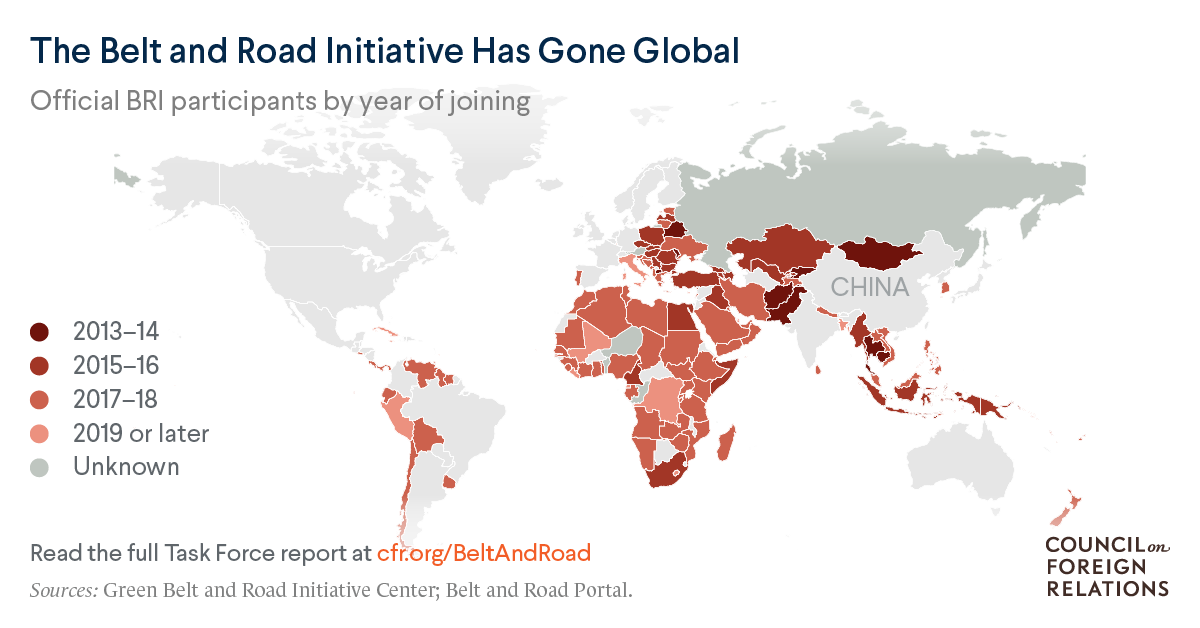
A trading connection between Saudi Arabia and Iran, both members of the BAR initiative, is vital for China. Interconnecting the highways and ports of the Middle East is part of the bigger picture.
Concluding Remarks
Despite the optimism in the air, we should still be cautious when assessing the situation. Diplomatic relations between the countries of the region provide great political and economic benefits, but the problems in Yemen, Syria and the other states where Saudi Arabia and Iran are rivals are yet to be addressed. This deal has clearly attracted the contempt of The United States and Israel, meaning there is a possibility it could fall through due to pressure or even sabotage, though the latter is of course speculative. Nonetheless, a region that is economically and culturally interconnected is a strong one that can align to bring forth the best policies for its people. We have yet to see whether the new relations are just a formality or a new dawn, but the people of The Middle East who have been living along a fault line deserve more safety and opportunity.