


Historical Attitudes of the State of Israel Towards Jordan: 1960s, 70s and 80s
Jordan managed to develop a competent Armed Forces and an efficient security service, meaning against all predictions, the country managed to remain stable. The monarchy’s more immediate problems came from Arab Socialists aligned with Egypt’s Nasser and the Ba’ath Party, Communists, and later, the PLO. This does not mean that Israel did not attempt to sabotage Jordan at this time. Recall the plan for a Jewish homeland from 1919, as well as Ben Gurion’s statements that any partitions and settlements are merely steps towards further acquisition of land. After the 1948 war and Palestinian exodus, the armistice agreements held that what we now know as the “West Bank” (Cisjordan) would remain Arab territory, since this was the land that Jordanian and Iraqi troops had successfully defended throughout the fighting. In 1950, Cisjordan was controversially merged with Transjordan to create the Hashemite Kingdom of Jordan.
In 1948, the Jews were unfairly promised half of historic Palestine, though they made up less than half of its inhabitants and owned only 6% of the country’s land. After the Nakba, they controlled around 75% of the country, all while killing and expelling the land’s Arab residents. Yet even after all this, expansion was to continue. The official Israeli narrative portrays the occupation of Arab territory after the 1967 war as an unintended consequence, something that occurred suddenly. As with most Israeli narratives, this could not be farther from the truth. Historian Adam Raz had uncovered documents from the early 1960’s where senior IDF officials asserted that a future war would necessarily involve occupying Arab territory, including Gaza, the Sinai, South Lebanon, the Golan Heights, Damascus, and most importantly, the West Bank. Officers spoke of “a convenient political situation [that] might develop which will make it possible to retain occupied territory indefinitely.” Surely enough, when Israel did occupy the West Bank, they stalled and evaded returning it to Jordan, ostensibly because of the cultural and religious significance it has for the Jewish people, just as Israel thwarts any attempt at Palestinian statehood today.
Israel’s unprovoked attack on Samu’ in 1966, where they fought Jordanian troops and destroyed most of the village, sparked riots and discord, which pressured Jordan into signing a defense pact with Egypt and joining the Six Day War. Now, Israel’s sights were on the East Bank. On March 21, 1968, 15,000 Israeli troops attacked the town of Karameh, claiming it as a retaliatory raid for Fatah attacks in Israel. The Jordanian Armed Forces, anticipating the attack thanks to the intelligence, defended the town and sent the Israeli troops back across the river. Though Israel presented its actions, which the United Nations condemned, as a raid, Jordan was not convinced. Given the size of the invading force, the Jordanian Armed Forces and Palestinian guerillas assumed Israel wanted to occupy the Balqa governorate and create a Golan-like situation to use as a bargaining chip. Declassified documents vindicate this view: Israeli troops had practiced crossing the Jordan River as early as 1966.
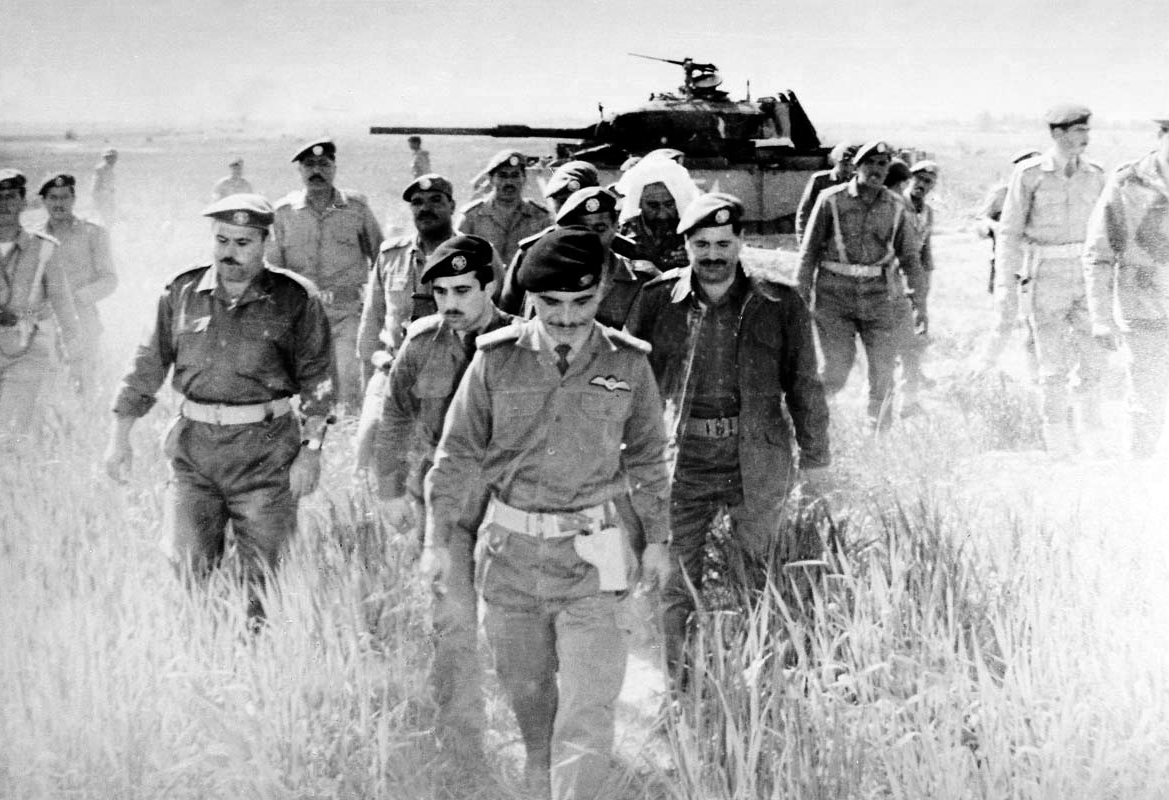
So, if the goal was to occupy the east of the Jordan Valley, fighting the Jordanians head on would not be a successful strategy. Even if Jordan was defeated, which Karameh demonstrated was no easy task, Jordan was an ally of the United States, and the Israelis feared their ire. The logical course of action was to wait for a “convenient political situation.” This would come in 1970, during a brief civil war between the Palestine Liberation Organization and the Jordanian State. When fighting erupted, the Israelis sought to take advantage of the situation.
There are two English sources which deal with primary accounts of what transpired during Black September. One is “the King’s Counsel” by Jack O’Connell, who was the CIA man in Amman, and later King Hussein’s lawyer in Washington. O’Connell had personal affinity towards the King, but his accounts offer a deep insight into the events, given his position. There is also the critically acclaimed and well-rounded biography of the late King Hussein, “Lion of Jordan”, written by Avi Shlaim. Both authors hold that Israel sought to occupy parts of Jordan during that trying time.
O’Connell: “While Nixon and Kissinger ruled out direct U.S. intervention, Kissinger asked the Israelis whether, if requested, they would attack the Syrian forces (who had invaded Jordan to support the PLO) by air. The Israeli’s reply was cagey. They said that an air attack alone would not be sufficient; they would have to invade by ground as well. The United States was alert enough to realize that once Israeli troops occupied that strategic ground, they would never leave. In any event, the King would have never approved Israeli ground troops in Jordan. He knew that Dayan, (then Israeli Minister of Defense), among others, had been very vocal that Israel should have taken the Jordan heights during the 1967 war, and would not fumble a second opportunity…Fortunately, the Israelis did not intervene by ground or by air.” (O’Connell, 104-105)

Shlaim provides a detailed account of internal Israeli attitudes to Jordan in this era. In 1969, when it was clear there was tangible tension within Jordan, Dayan said he would “have to implement a particular plan. He was not specific, but it was probably for the capture of certain areas that were considered essential for Israel’s security”. (Shlaim, 309) A few pages later, Shlaim recounts the Israeli cabinet’s discussions upon receiving Kissinger’s message. There were two schools of thought. One group supported Hussein, considering relations between Jordan and Israel were more cordial than those with other neighbours. “Another group was in favour of turning the Hashmeite Kingdom of Jordan into a Palestinian state. The more extreme members of this group advocated active Israeli support for the PLO in bringing this about. Yasser Arafat’s declaration of independence in Irbid helped members of this group to press their case. They recommended allowing the PLO to achieve its goals and gain control of the whole country. For them this was the ideal solution to the problem of Palestinian independence.” (330-31)
More “moderate” cabinet members (moderate is generous) such as Meir, Allon, Eban and Rabin advocated for King Hussein. More right wing leaders such as Rehavam Ze’evi, a notable advocate of population transfer, and Ariel Sharon, the “butcher of Beirut”, vouched for the alternative homeland plan. Dayan and Peres, too, took an anti-Hussein line. In the end, Israeli support wasn’t necessary, for the Jordanians had soundly defeated the PLO and Syrians in ten days. The only Israeli action consisted of flying over retreating Syrian troops and releasing sonic booms to acquiesce Kissinger (who did nothing, in reality) and show the Syrians what might happen if they tried such a thing again. The Israelis even had a contingency plan to occupy regions corresponding to those included in the 1919 plan in the event the Jordanian state collapsed. (332)
Since then, Israel has never stopped looking for opportunities to implement either plan. The closest the Zionists have come since Black September was during their invasion of Lebanon in 1982. At this time, the Likud party governed Israel, the same party the current Prime Minister Netanyahu is a part of. Their goal, in essence, is to expand Israel’s borders and create “living space” for the Jewish people. In the first clause of their party manifesto, it is written that “between the Sea and the Jordan there will only be Israeli sovereignty.” In the ‘80s, they aimed to accomplish this fascist fantasy in a number of ways. Prime Minister Begin authorized the building of an unprecedented number of settlements, making any attempt to cede the West Bank overly difficult for decades to come. The hallmark of their administration was the Israeli attack on Beirut and the subsequent massacre of thousands of Palestinians and Lebanese. At the time, the invasion was portrayed as a defensive measure to clear the PLO from Israel’s borders. In reality, this war, the brainchild of defense minister Sharon, was a regional plan. His idea was to kick the PLO out of Lebanon. The subsequent destruction of Palestinian political structures would weaken resistance in the West Bank. This chain of events would culminate in the PLO going to Jordan, a phenomenon the King would not be able to handle (as though he hadn’t done so a mere 12 years before), and then, Jordan would become the Palestinian state. (416)

Sharon stated that if he were Prime Minister, he would go as far as to directly aid the PLO and give the King 24 hours to leave. (416) When he proposed this to Arafat, the PLO Chairman adamantly rejected this idea. Upon hearing Arafat’s reply, Sharon let out an obscene curse in Arabic. (417) Why bring up all of these historical examples, one may ask? The radical right wing that exchanged power with more centrist Zionists historically now completely dominates the Israeli government. The factions and figures who tried to compromise Jordan’s sovereignty in decades past harbor the same ideology as those who are currently committing genocide in Gaza. In the same light, just as Likud aimed to empty the West Bank and make Jordan an alternative homeland in the past, they are attempting the same sinister scheme today. It is of extreme importance that Jordanians, Palestinians and supporters of the Arab nation worldwide are aware of this plan, so they are not deceived, for Zionists are masters at deception. Part of this is portraying Jordan as the first line of defense for Israel, a frivolous charge aimed at causing discord in Jordanian society. Said discord would destabilize Jordan and give Israel the space to put their conspiracies into action. Against a powerful adversary backed by the global superpower, Jordan must act carefully. However, the aforementioned charge benefits no one more than the Zionists themselves.
Mythbusting: 1973 meeting between King Hussein and Golda Meir
Aside from technical tactics used to make infighting a mainstay of Jordanian internet discourse, Israel misrepresents events in order to play up Jordan’s relations with Israel. This phenomenon has increased substantially since October 7, but the misconstruing of historical events has been occurring for some time. The Israelis are aware that history has a profound effect on modern perceptions. To this effect, portraying the ruling dynasty of Jordan as collaborative would serve as a justification for Arabs who aim to plot against it. An unstable Jordan benefits Israel, so what would benefit Israel more than convincing Jordan’s population, who are unwaveringly loyal to the Palestinian cause, that the country’s ruling dynasty constantly betrays said cause?
The example that comes up most frequently is a secret meeting between King Hussein and then Prime Minister Golda Meir. Director of the Prime Minister’s Office, Mordechai Gazit, and Jordanian Prime Minister, Zaid Rifa’i, were also in attendance. Claims emerged from Israel in the coming weeks that King Hussein had come to Tel Aviv to warn Meir about the impending Egyptian-Syrian attack, and Meir stubbornly ignored this. To this day, the myth is parroted by Israelis and Arab opposition to Jordan alike. In 2013, the Times of Israel ran an article with the headline claiming that the “Account of King Hussein’s 1973 war warning (was) still deemed too harmful for release.” This is a lie of the highest order. The late King could not have “warned Israel”, because he did not know about the upcoming war. He was just as surprised as Nixon and Kissinger were. The other lie is the fact that this meeting has been written about in both the books mentioned, which both came out years before the Times of Israel, a known concoction of Hasbara garbage, “reported” about it. We will analyze O’Connell’s first hand account of the incident, and then look at Shlaim’s account, which was formed after an extensive review of documents and interviewing all attendees barring Meir.

O’Connell writes that the Egyptians and Syrians had done a brilliant job at camouflaging their preparations, but Jordan had an indication of what may have been going on. Jordan’s military intelligence were contacted by a senior Syrian officer, who was opposed to the war and the Syrian regime. He did not ask for compensation. Once smuggled into Jordan, he drew a complete picture of the Syrian plan, with maps and all, though he had no knowledge of the Egyptian plan. The director of military intelligence, Aboud Hassan, was entirely convinced, but the King thought it was nonsense. He was in Cairo from the 10th to the 12th of September, where he met with Sadat and Assad. He did not get the slightest impression that a war was imminent. This prompted King Hussein to go on what O’Connell called a “fishing expedition”. This is the meeting with Meir. The King aimed to probe as to whether the Israelis knew about any war plan. The King returned even more unconvinced that another Arab-Israeli clash was on the horizon. (O’Connell, 122-23) He learned that the Egyptians and Syrians had attacked during a motorcycle ride on the outskirts of Amman. (Shlaim, 363)
Shlaim copied down the excerpt of the bit that some contend is the King’s “warning” to Golda Meir. It’s a bit long to quote here, but the King suggested that Syria’s troops were now in attack formation. What the King indicated in the conversation was that Israel could no longer stall the peace process, because the Arabs would have no choice but to regain their territory by force. After the meeting, Meir forwarded this information to Israeli experts, who almost unanimously agreed that nothing of importance was said; the IDF had already known about the Syrian military deployment. The King mentioned no specific detail; no manoeuvres or dates were revealed. (361-362) This lends credence to O’Connell’s claim that King Hussein wanted to see if the Israelis would give up further details, but they had no more knowledge than he did. The definitive proof that the King did not know of the war plan comes from an unlikely source, Abu Iyad of the PLO. In his memoirs, he writes that he and other leaders of the PLO met Sadat the day prior. The Egyptian President said that he did not intend on breathing a word about the plans to the King. The purpose of the summit was to restore relations with Jordan, which Egypt and Syria had broken off earlier, to make the situation “normal” along the Eastern Front. (360)
The King and Rifa’i both denied he had warned the Israelis of the war effort, obviously. (363) But even Gazit said that the controversial account of the meeting was baseless. He stated that “Hussein did not come to talk about something that was about to happen immediately but to warn that the situation was intolerable and could not go on like that indefinitely.” So, where did the claim Meir got a warning and dismissed it originate? It comes from Eli Zeira, who was Israel’s Director of Military Intelligence at this time. Amidst this massive intelligence failure, he, along with Chief of Staff David Elazar, were forced to resign, while Meir and Dayan, the two individuals who produced the policy failure that caused the war, were not. Here, Zeira wanted to shift the blame, and presented an account of the meeting that those present vehemently rejected. (364) At the time, this distorted account was used as a form of political vengeance. Now, it is clearly being used as one cog in a Zionist machine which aims to cause strife in Jordanian society. One must point out the sheer lack of critical thinking of those who repeat allegations made by Zionist outlets. You would never accept the Jerusalem Post or Times of Israel’s accounts of events in Palestine. Why, then, do you eat up and regurgitate everything they say about Jordan?