


By an anonymous writer
Canada, a settler-colonial state founded upon the genocide of indigenous Canadians, is no stranger to ethnic cleansing and systemic discrimination. In fact, Canada provided the layout for South Africa’s apartheid system, which was patterned after Canadian policy towards First Nations [1]. Just as Canada gave South Africa financial and diplomatic support during its apartheid era, it is currently complicit in the crimes of Israel, which has been officialy classified as an apartheid state in a lengthy report by Human Rights Watch. While the CBC refuses to acknowledge the existence of the report, and Canada’s role in abetting Israeli crimes, this article aims to uncover Canada’s role in the creation of Israel, its support for ethnic cleansing and apartheid, disregard for international law, and recent developments concerning Canadian policy towards Israel. This article comes at an important time, as the Israeli state is currently in the process of forcefully expelling Palestinians from their homes in East Jerusalem. This event is not an aberration, but rather one part of a roughly 70 year process of ethnic cleansing and dispossession, which Canada remains complicit in.

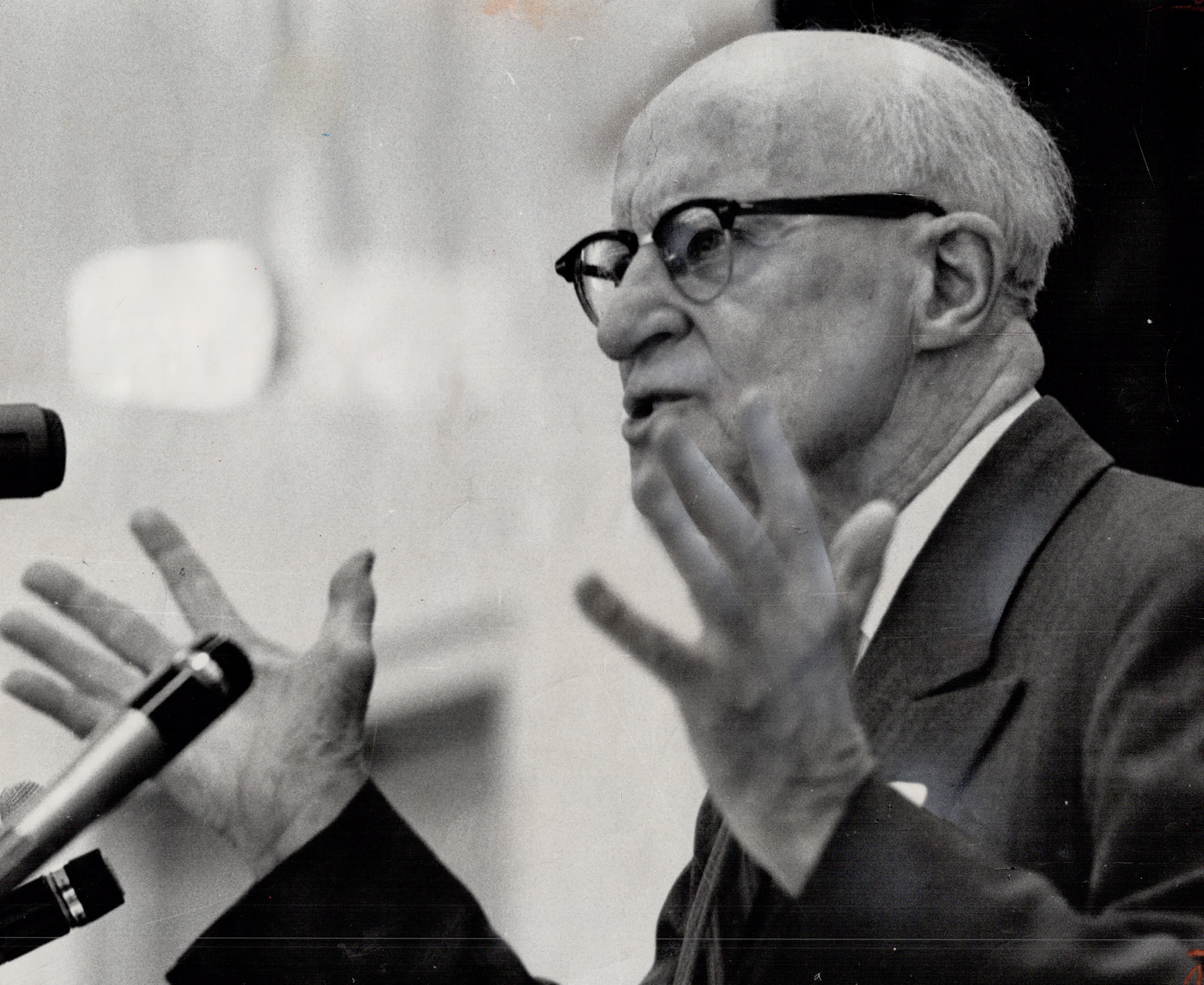
Following the British withdrawal from Palestine in 1947, Canadian diplomats played a major role in the partition of Palestine. Ivan C. Rand, a Zionist, was the Canadian representative to the United Nations Special Committee on Palestine (UNSCOP), which was charged with settling political disputes in Palestine. According to Israeli historian Ilan Pappe, Rand viewed the struggle between the two groups as one of progress (Jewish settlers) versus backwardness (Palestinians) [2]. Rand’s role in the ensuing events was not miniscule. Rand firmly supported the Balfour declaration, which was the British Empire’s statement of support for a Jewish state in Palestine. He opposed proposals for a unitary Jewish-Arab state, and drafted the papers demanding a partition [1]. According to the Canadian Jewish Reference Book and Directory, “Judge Rand’s understanding and judgment influenced the commission to recommend the final solution to a problem that troubled the world – the establishment of a separate Jewish state in Palestine” [3]. Following the creation of UNSCOP’s proposals, a UN ad-hoc committee was formed to vote on the proposals. Lester B. Pearson, who was then the under-secretary of state for External Affairs, headed this committee and played a major role in the partition vote. Pearson wrote, “I have never wavered in my view that a solution to the problem was impossible without the recognition of a Jewish state in Palestine. To me this was always the core of the matter” [4]. On October 17, 1947, Canada and thirteen other nations approved the partition plan. Canada’s vote was decisive, as thirteen nations had opposed the plan. The partition gave the newly formed Jewish state a majority of Palestinian land, despite the Jewish population owning only 6% of the land and making up 30% of the total population. Pappe found that even within territory to be allotted to “the Jewish state”, Jews owned 11% of the land and were a minority in every district [5]. According to a dissident within External Affairs, Elizabeth MacCallum, Canada supported a partition plan which was wholly un-democratic [6]. A representative from the Canada-Arab friendship league said “Our Canadian government at one time also favoured the creation of a federated State of Palestine which had at least some resemblance to a democratic solution. Unfortunately, as you all know, Canadian delegates, Mr. Lester B. Pearson and Mr. Justice C Rand, changed that official position of our government. Instead of the democratic solution, these gentlemen did their utmost to impose upon the Arabs the infamous partition scheme. The Arab world, I am sure, will remember them” [7]. Canada’s support for the creation of a Jewish state was in part motivated by anti-Semitism. Canada only permitted 5000 Jews to seek refuge in the country between 1933 and 1945, and did not intend to increase the influx of Jews following the Second World War. Canada and the United States both viewed the partition plan as an effective way of redirecting Jews away from their shores [1]. Canadian historians Harold Troper and Irving Arbella attested that “The Canadian delegation at the United Nations went into the Palestine debate briefed from Ottawa on what a negative majority vote on partition would mean to future discussions of European displaced persons. And Canada voted for partition” [8]. The second factor which motivated Canada’s vote was geopolitics. According to a report at External Affairs, “The plan of partition gives to the western powers the opportunity to establish an independent, progressive Jewish state in the Eastern Mediterranean with close economic and cultural ties with the West generally and in particular with the United States” [4]. In short, Israel played an important role in maintaining and expanding Western hegemony in the Middle East.
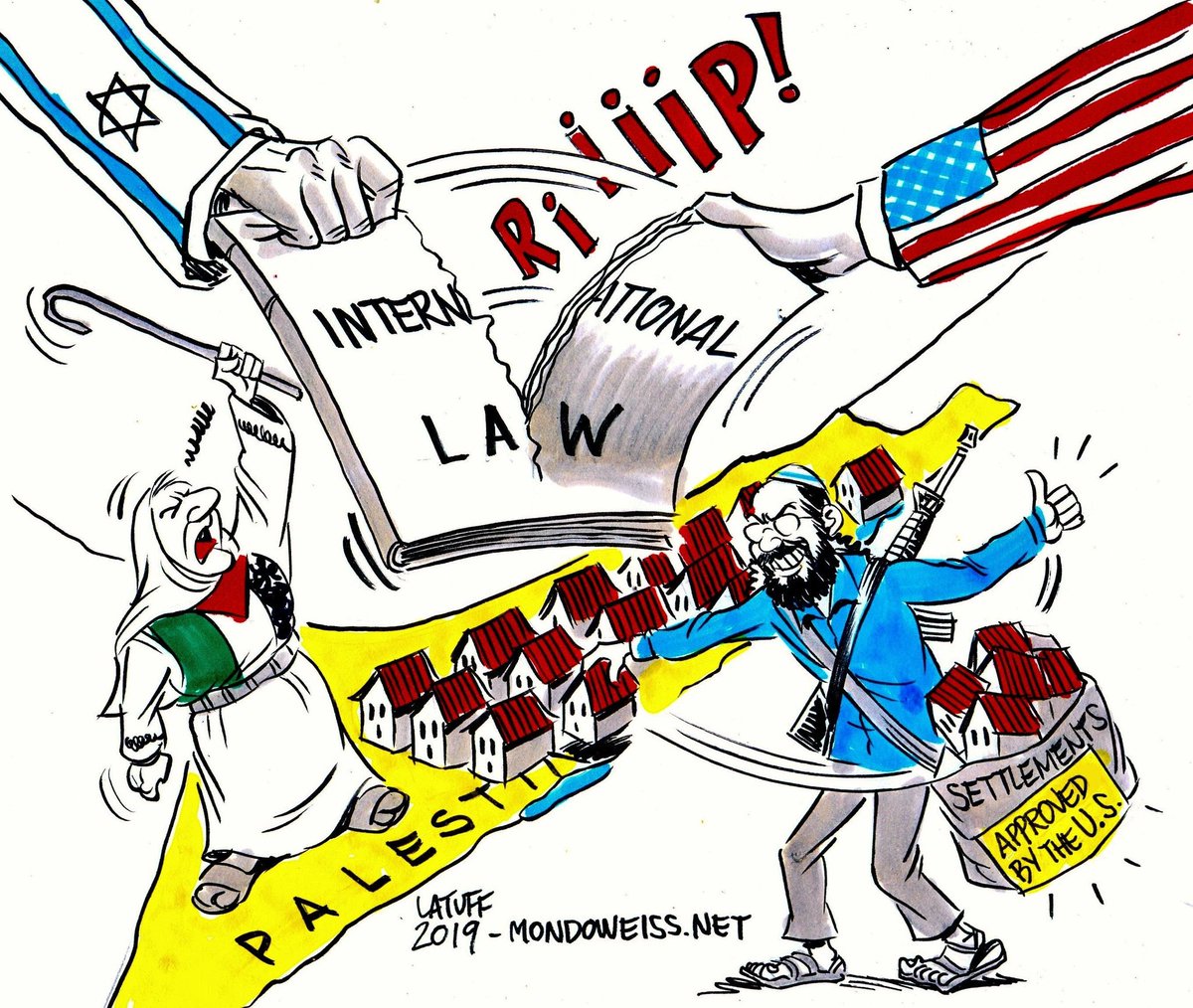
Canada also played a role in the ethnic cleansing of Palestine following the partition which resulted in 700,000-900,000 people being displaced. The Haganah, a Jewish military force notorious for its violence against Palestinians, recruited over 1000 Canadians, most of whom were veterans of the Canadian Armed Forces. Canadian troops played an active role in depopulating Palestinian villages and initiating the process of disposession that continues to this day [1]. During the 1948 war, Israel’s air force was composed of many Canadians. Canada did not prevent this recruitment even though the government had banned foreign recruiting during the Spanish Civil War, when many Canadians wished to join the anti-fascist forces. Illegal recruitment into the Israeli military is ongoing, as the Israeli consulate continues to recruit young Canadians into the Israeli Defense Forces in violation of the Foreign Enlistment Act. Israel’s ethnic cleansing of Palestine persists through the creation of illegal settlements in the West Bank, which aim to replace the indigenous Palestinian population with Jewish settlers. As Yves Engler explains, Canada has been either complicit in this process of forced dispossession, or an active participant. After the 1967 war, Canada financed the construction of Canada Park in the West Bank in violation of international law, contributing to the displacement of residents [1]. Canadian corporations were involved in the construction of the Trans-Israeli highway, which is an essential part of the apartheid infrastructure of Israel, since it can only be accessed by settlers [1]. In 1997, Canada further legitimized the occupation of Palestine by signing a free trade agreement with Israel. The agreement included the West Bank and Gaza as areas where Israeli customs and tariffs apply, even though these areas are not internationally recognized as a part of Israel. In contrast, the European Union’s trade agreement with Israel does not include areas under illegal occupation [1]. In 2008 Canada refused to condemn the building of illegal settlements in at Harhoma (near Jerusalem), which even the United States had condemned [9].
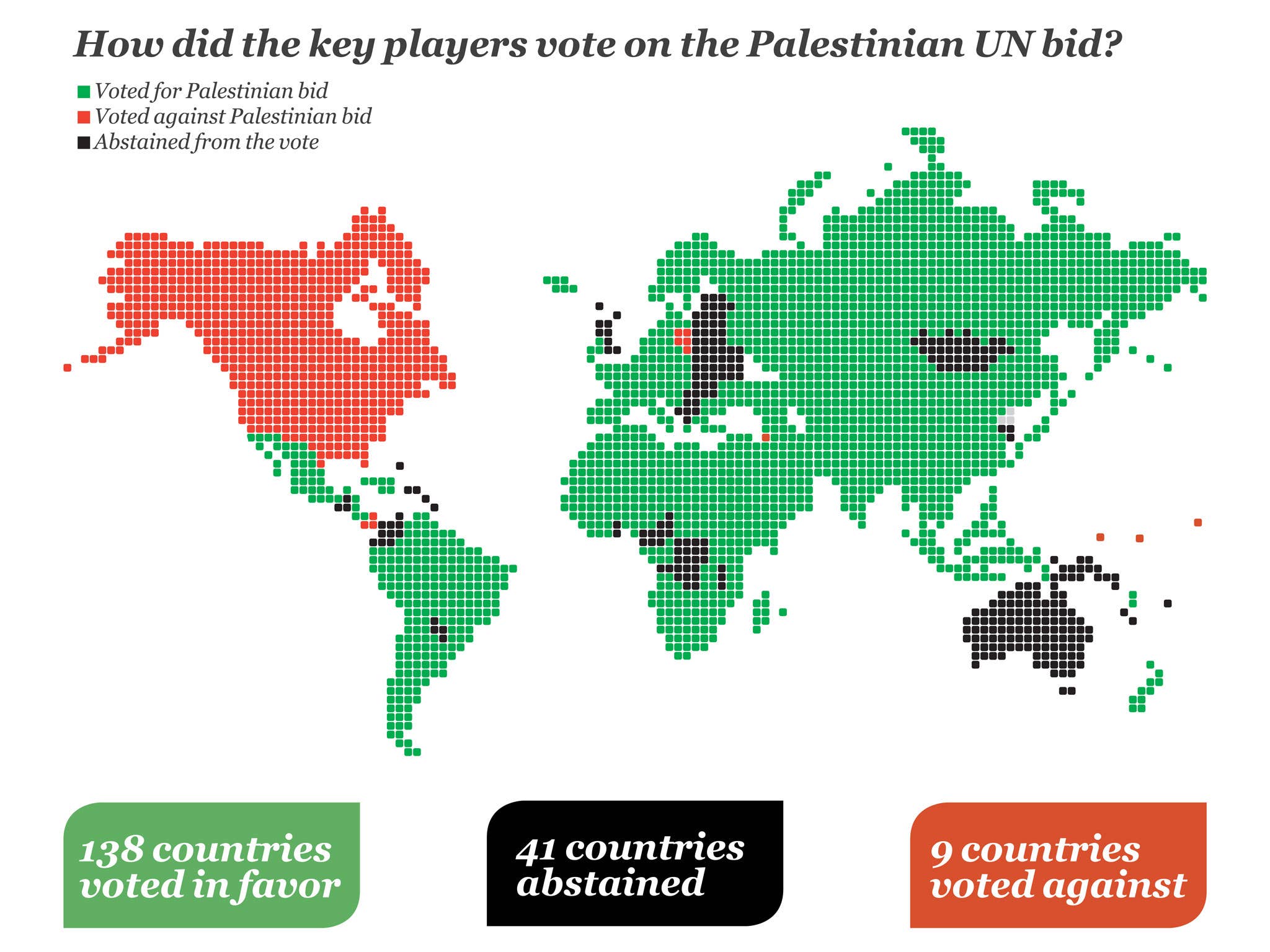
Canada’s voting record in the United Nations has been consistently in favour of Israeli aggression, in opposition to world opinion. In 1982, the United Nations General Assembly called for the creation of a Palestinian state, and for Israel’s withdrawal from lands captured in 1967. Canada was one of the four countries to cast a negative vote [1]. In 1987, Prime Minister Brian Mulroney refused to condemn the brutal suppression of the first Intifada, which resulted in the death of nearly 2000 Palestinians (311 in the first year), claiming that Israel had acted with restraint. Humanitarian organizations estimated that “23,600 to 29,900 children required medical treatment for their beating injuries in the first two years of the Intifada, one third of whom were children under the age of ten years” [10]. In 2000, the Chretien government opposed a United Nations resolution “calling for observers to the occupied territories to protect the security of Palestinian civilians. Canada’s reason for rejecting the resolution was that Israel, the occupying power, had not accepted the idea of observers” [1].
Although Canada had been fervently pro-Israel in previous administations, the Harper government took it to new extremes. When Hamas won the the Canadian monitored elections of 2006, Canada proceeded to cut aid to the Palestinian government. The Harper government was following the lead of Dov Wiseglass, the Israeli Prime Minister’s senior advisor, who composed a plan to “Put Palestinians on a diet” [1]. The aid was cut off due to Hamas’s refusal to recognize Israel, yet Likud’s refusal to recognize Palestine as a state has not strained Canada’s relationship with Israel in any way. The Harper government was also complicit in Israeli militarism by supporting the invasion of Lebanon in 2006. While Pierre Trudeau had at least nominally condemned Israel’s invasion of Lebanon in 1982 (although parliament refused to condemn Israeli backed massacres), Harper viewed the Israeli assault in 2006 as a “measured response” towards Hezbollah provocations [11]. Two days after this statement, Israel killed a Lebanese-Canadian family, including four children. Canada continued to endorse Israel even after over a thousand civilians had been killed, often with Canadian made weapons [1]. When Israel bombed a UN compound resulting in the death of Canadian Major Paeta Hess-Von Kruedener, Harper questioned the UN for keeping its compound in a dangerous area. The UN inquiry on the bombings concluded that there was no justification for the attacks on UN positions, and that the acts “Constitute a clear violation of international law and international humanitarian law” [12].
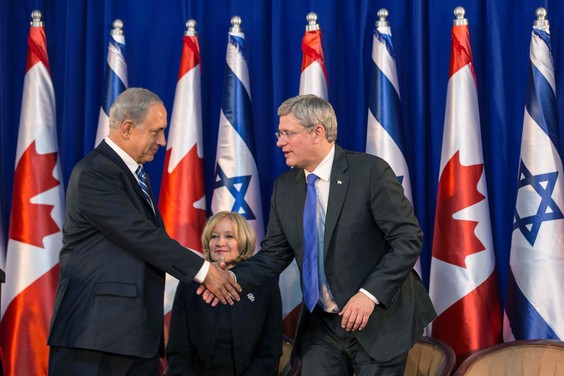
As Engler notes, The Harper government chose to ignore the report, refusing to hold Israel accountable for the death of a Canadian Major. The Harper government’s voting record at the UN further illuminates Canada’s partiality towards Israel. In 2008, Canada was the sole country at the United Nations Human Rights Council to vote against a resolution which called for international actions to put an end to the siege of Gaza. Months later Canada was the sole country at the UNHRC to vote against a resolution condemning Israeli war crimes in its March 2008 invasion which killed more than 120 people [1]. In addition there are the 16 yearly UN resolutions on the conflict which include “Issues such as sovereignty, refugees, East Jerusalem, human rights, settlements and holy places” [13]. In 2003, Canada voted in favour of most resolutions, yet the Harper administration initiated a shift away from the global consensus, as Canada recorded its first negative votes in 2004. In 2011, Canada voted negative on 14 resolutions and abstained from the other two, fulfilling Harper’s goal of becoming the most pro-Israel country in the world [14].
While the Trudeau government has largely inherited its voting record from the previous administration, it has initiated a slight shift away from the minority pro bloc by voting in favour of Palestinian self-determination. In an attempt to gain a seat at the UN security council, the Trudeau government voted in favour of a resolution which “Criticizes the barrier wall Israel has built close to (but not always on) the 1949 armistice line that most countries consider to be the real border of Israel,” in both 2019 and 2020. These two votes are the only instances where Canada has affirmed Palestinian rights since 2010. There have been 67 “no” votes during the Trudeau era alone [15]. In a controversial move, the Trudeau government has adopted the definition of anti-Semitism provided by the the International Holocaust Remembrance Alliance (IHRA), which conflates criticism of Israel with anti-Semitism [16] [17]. According to Independent Jewish Voices Canada (IJV), which opposes the IHRA definition, this definition aims to “Ban or criminalize deep criticism of Israel and Zionism, and suppress support for Palestinian rights” [18].
A glimmer of hope remains for Palestine activists, however. The New Democratic Party (NDP) has recently passed a resolution which calls for “Ending all trade and economic cooperation with illegal settlements in Israel-Palestine” and “Suspending the bilateral trade of all arms and related materials with the State of Israel until Palestinian rights are upheld.” According to IJV Canada, “The adoption of this resolution marks one of the most progressive positions on Palestine adopted by a major political party in Canada” [19]. Another NDP resolution, which has yet to see the floor, rejects the IHRA definition of anti-Semitism. Whether the resolution passes or not, the message to Jagmeet Singh, leader of the NDP is clear: Canadians want an end to Israel’s oppression of Palestinians. As opinion polls show, Canadians oppose the annexation of Palestinian territory. While Jagmeet Singh, unlike Trudeau (at the time of writing), has condemned the forced expulsions taking place in Sheikh Jarrah, his words will be meaningless if they do not translate into policies. Hopefully, the recent resolution passed at the NDP convention will be the first of many, and Canada ends its longstanding support of ethnic cleansing and apartheid.
Disclaimer: The views and opinions expressed in this article are solely those of the author and do not necessarily reflect the views of 9awtak.com, its staff, or other contributors.
Sources:
- Black Book of Canadian Foreign Policy
- Making of the Arab-Israeli Conflict
- Canadian Jewish Reference Book and Directory
- The Domestic Battleground
- The Ethnic Cleansing in Palestine
- Personal Policy Making: Canada’s Role in the Adoption of the Palestine Partition Resolution
- Canada and Palestine
- None is Too Many
- https://www.theglobeandmail.com/news/world/berniers-silence-raises-questions/article17978290/
- The Israel Lobby
- https://www.theglobeandmail.com/news/world/harper-defends-israels-right-to-defend-itself/article18167473/
- https://www.securitycouncilreport.org/atf/cf/%7B65BFCF9B-6D27-4E9C-8CD3-CF6E4FF96FF9%7D/Lebanon%20A%20HRC%203%202.pdf
- https://www.cbc.ca/news/politics/un-palestinian-vote-canada-israel-us-1.5365637
- https://www.israelnationalnews.com/News/News.aspx/127730
- https://www.justpeaceadvocates.ca/un-vote-analysis/
- https://canadiandimension.com/articles/view/yes-the-ihra-definition-of-anti-semitism-is-intended-to-censor-political-expression
- https://www.972mag.com/canada-ihra-antisemitism-palestinians/
- https://www.ijvcanada.org/fighting-antisemitism-is-essential-but-the-ihra-definition-is-the-wrong-approach/
- https://www.ijvcanada.org/ijv-applauds-ndp-convention-delegates-for-passing-the-palestine-resolution/


Well written and very well documented. Excellent article.