

By Rashid Kassim
The United States of America in the Middle East: From Glory to Ruins (Part I)
Throughout time, the Middle East has been known to be the region of power, unity, stability, and economic prosperity. In recent years, that has not been the case. Western intervention has infiltrated the region since the collapse of the Ottoman Empire, but it is US intervention that has been particularly cruel. This exploration will essentially outline historic examples of US intervention in the Middle East and ascertain the resulting consequences.
The Opening Act: The US in Afghanistan
One of the most prominent American maneuvers in the Middle East came in late 2001, with an operation focusing on ousting the Taliban of power in Afghanistan. President George W Bush signed into law a joint resolution “authorizing the use of force against those responsible for attacking the United States on September 11”. In other words, President Bush waged a war that ensured the destruction of Afghanistan from all ends. What was quite riddling is the number of reported casualties in Afghanistan, which added up to 243,000 casualties according to the Watson Institute of Brown University, in contrast to the Taliban being shaped by only 75,000 members.
These damages do not fully represent the extent of disorder Afghanistan entered into after the US invasion. Such disarray can be found in the number of Afghan refugees who have been displaced. According to the UNHCR, “more than 3 million people in the country remain displaced from their homes”, which is evidently a result of the war. In addition, 25 million Afghans currently live in poverty, while 6 million people are on the brink of famine, with 1 million children facing malnourishment.
Recently, the “Special Inspector General for Afghanistan Reconstruction” released a report detailing the damages of the war and delineating strategies used to aid in Afghanistan’s development. An intriguing statement found within the report suggested that “the U.S. government struggled to develop a coherent strategy, understand how long the reconstruction mission would take, ensure its projects were sustainable, staff the mission with trained professionals, account for the challenges posed by insecurity, tailor efforts to the Afghan context, and understand the impact of programs”. Such statements suggest that the United States has openly admitted to causing instability in Afghanistan, and to being incapable of aiding development in Afghanistan, after causing a hindrance in the country.
Such atrocities have left casualties and resulted in displacement, ultimately leaving a dent in Afghanistan as a whole. Additionally, empirical evidence suggests that the American invasion has proven to be a direct cause of the impediment to Afghanistan’s economy, institutional sturdiness, and overall cultural development. Moreover, any attempts made by the US to revitalize the elements that shape a modernized, educated, and developed society and state have ultimately failed. Such conclusions could be drawn from the remarks made by the Special Inspector General for Afghanistan reconstruction.
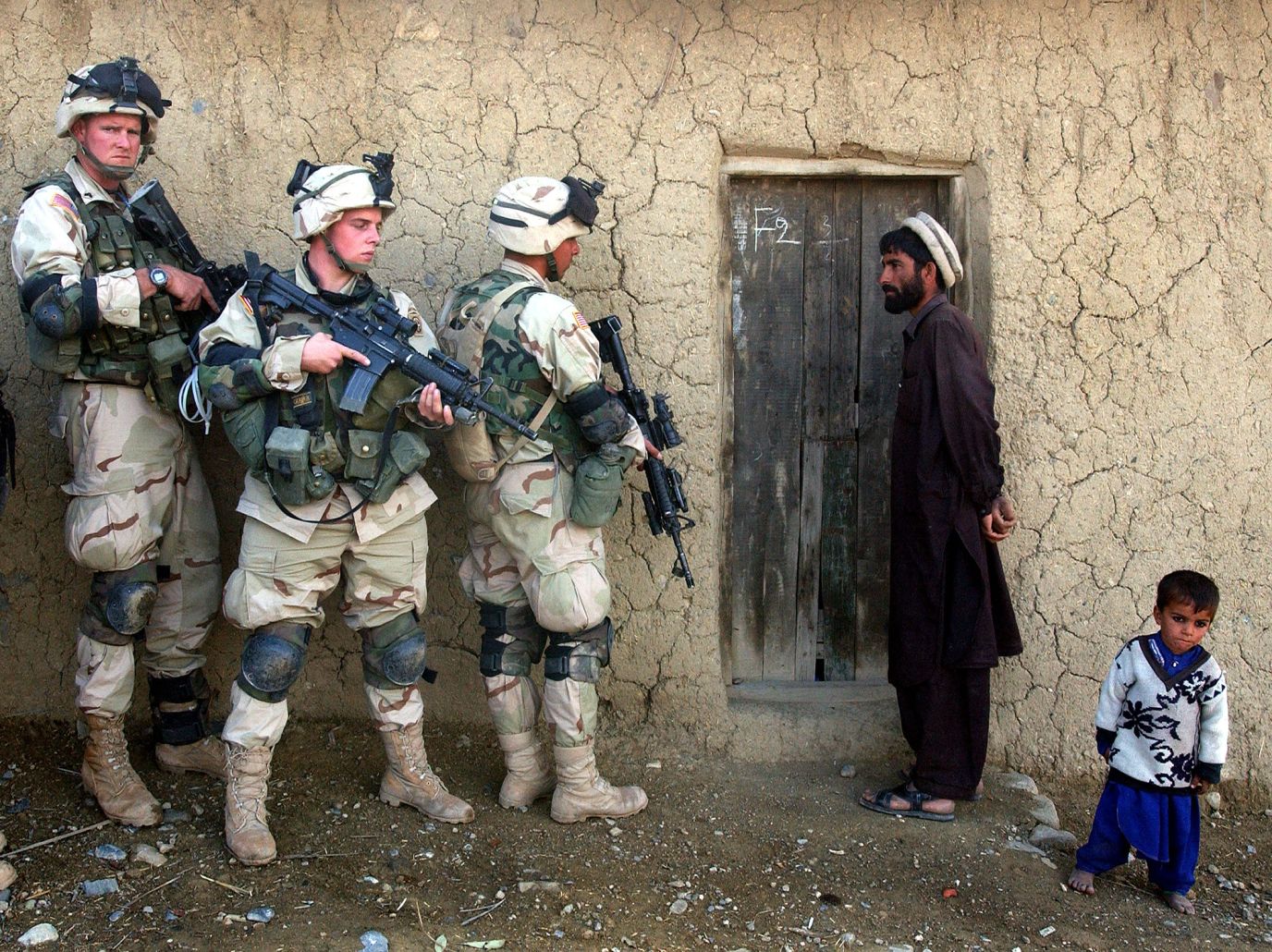
An Afghan man looks at US soldiers who prepare to sweep his home. Though America swiftly occupied the country, it failed to build lasting institutions, partly because of their diversion to Iraq. (Scott Nelson, Getty Images)
Ride the wave or be crushed: The US in Iraq
The US slashed a wound in the Middle East on the 19th of March in 2003 when it invaded Iraq. According to the Watson Institute of Brown University, the US military was responsible for between 275,000 to 306,000 casualties “by direct violence since the US invasion.” In addition, the World Bank released a report highlighting the infrastructural collapse that followed after the invasion. Results suggested that the US was directly responsible for $47.5 billion in infrastructure damage, which involved the destruction of “houses, power plants, schools, and other civilian infrastructure.”
It is important to emphasize looking beyond such damages, which are relatively insignificant in comparison to the long-term damage Iraq has had to face as a result of the U.S invasion. Following the downfall of Saddam Hussein’s controversial regime, ISIS saw the state Iraq was in and became particularly influential within Iraq’s borders. Some may argue that there is no direct correlation between the US’s disbandment of the Iraqi army and ISIS’s rise in Iraq, but the organization spawned from the US disbandment of the Old Iraqi Army in 2003. Furthermore, the American destruction of institutions allowed ISIS to devour swathes of Iraqi territory a decade later.
On another note, the US invasion resulted in uncertainty and fear among Iraqi citizens. Such fear pushed citizens to seek refuge in more stable neighboring countries. In fact, according to UNHCR, 1.2 million Iraqi citizens have been displaced, while 4.1 million Iraqi citizens require humanitarian assistance. Such stunning numbers reflect that there has been an abysmal standard of living in Iraq in comparison to historical records prior to the invasion.
The hindrance of a once precious, glorious, and proud Iraq was an event of high significance, and accountability should be held by the beholder. The United States of America has always preached about peace, although upon recalling the countless times the US has acted as an aggressor, and an instigator, one can come to the conclusion that the United States of America has not practiced its preachings, and resorted to bloodshed and shear violence which has permanently left a scar in Iraq’s economy, political influence, and social development.

On April 9, 2003, Iraqi civilians and American soldiers toppled a statue of former President Saddam Hussein in Baghdad’s Firdos Square. While many Iraqis celebrated the end of his rule then, now, they’ve experienced unimaginable tyranny. (Goran Tomasevic, Reuters)
Conclusive Remarks
To conclude, it is vital that one acknowledges the inability of a country to invade another in hopes of democratizing it. Tanks and guns are inadequate when coupled with education and quality of life. The former may never result in the latter, and this is evidenced by the different and not-so-friendly appearances the United States has made in the Middle Eastern region. This short paper explored the correlation between the US’s foreign policy in the Middle East, and the deterioration of states found to be under the scope of the US.
One must indulge in the process of activism. Holding the United States accountable for the war crimes, terror, bloodshed, and inhumanity it has spread amongst the Middle Eastern region for security and apparatus is a must. Finally, history may be written by the victors, but the victors can’t wipe out all other perspectives, for “history is in the eye of the beholder”.